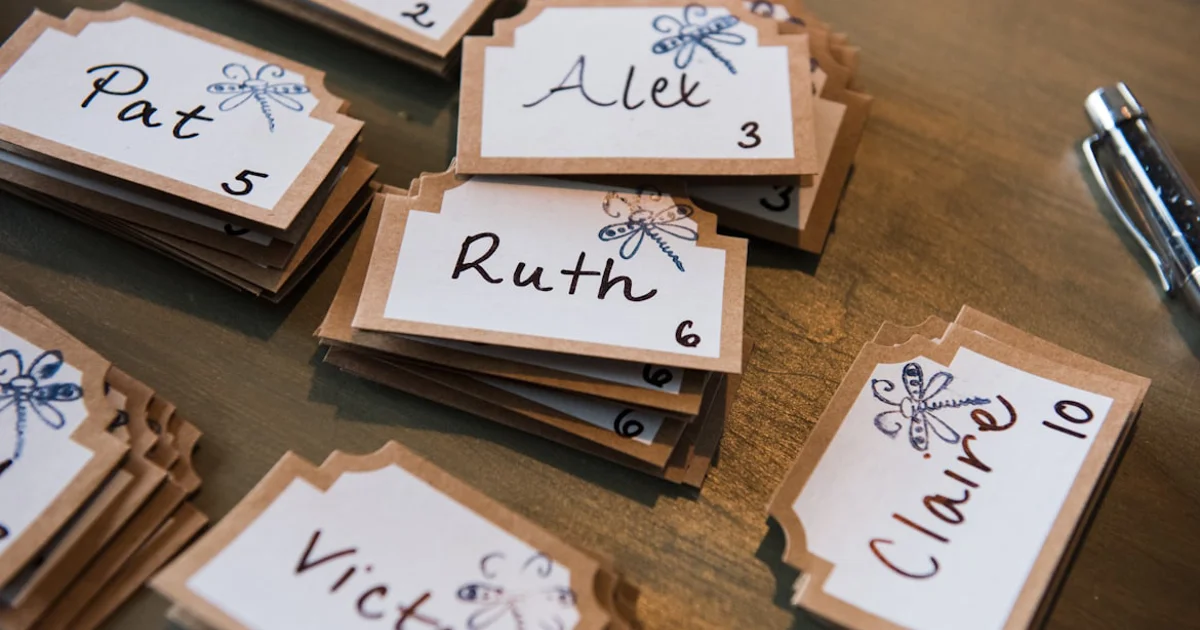
Here is the truth about wedding seating charts: there is no version of this task that is not a little annoying You are arranging the social lives of people who have nothing in common except loving you, and you are doing it in a grid.
But there are better and worse ways to do it, and the better way mostly comes down to doing it in the right order.
Wait until your RSVPs are final.
Do not start building your seating chart until your RSVP deadline has passed and you have chased down the stragglers. Building a chart around a guest count that keeps changing will make you redo it multiple times. Wait. Then do it once.
Start with the anchors.
Every reception has a few tables that are easy to assign: the immediate family table near the couple, the table of college friends who all know each other, the table of work colleagues who will be fine together. Place those first.
The people who are genuinely difficult to seat are almost always a small number. Do not let those few difficult placements paralyze the whole chart. Place the easy ones first and then deal with the hard ones when most of the work is already done.
Think in groups, not individuals.
Your goal is not to engineer perfect conversations. Your goal is to ensure nobody is at a table where they know absolutely no one and have nothing in common with anyone around them. That is the bar.
Group people who share some connective tissue: a neighborhood, a workplace, a stage of life, a shared friend. They do not need to be best friends. They just need a place to start.
Consider the physical layout of the room.
Tables near the dance floor tend to get louder and stay up later. Tables near the exit see people leave earlier. Tables near the bar get more traffic. Think about where you put elderly relatives and young children versus where you put your most enthusiastic friends.
It is also worth noting: the couple's table, wherever it is, will feel isolated if it is too far from the rest of the room. You want to be in the middle of the energy, not observing it from a distance.
Use a tool that lets you drag and drop.
Do not do this in a spreadsheet. Use something visual where you can see the table layout and move people around easily. Vowlio has a seating chart tool built in. It is free and it saves automatically.
Do not agonize over perfection.
Guests are adults. They will find people to talk to. They will move around during dinner. The seating chart matters most for the first thirty minutes of the reception. After that, people self-organize. Your job is to give everyone a reasonable starting point, not a perfect social experience.
Do it, send it to your venue, and move on.
Vowlio has a seating chart tool built in. It is free and it saves automatically. Sign up now to use it.
Vowlio brings the whole wedding into one place: your budget, guest list, seating chart, day-of timeline, vendor search, and wedding website. See everything Vowlio does for couples.
And if you are the vendor rather than the couple reading this: Vowlio puts a bookable profile in front of couples who are planning right now, and keeps your leads, contracts, and invoicing in one place. See how Vowlio works for vendors.
With love, Verla